
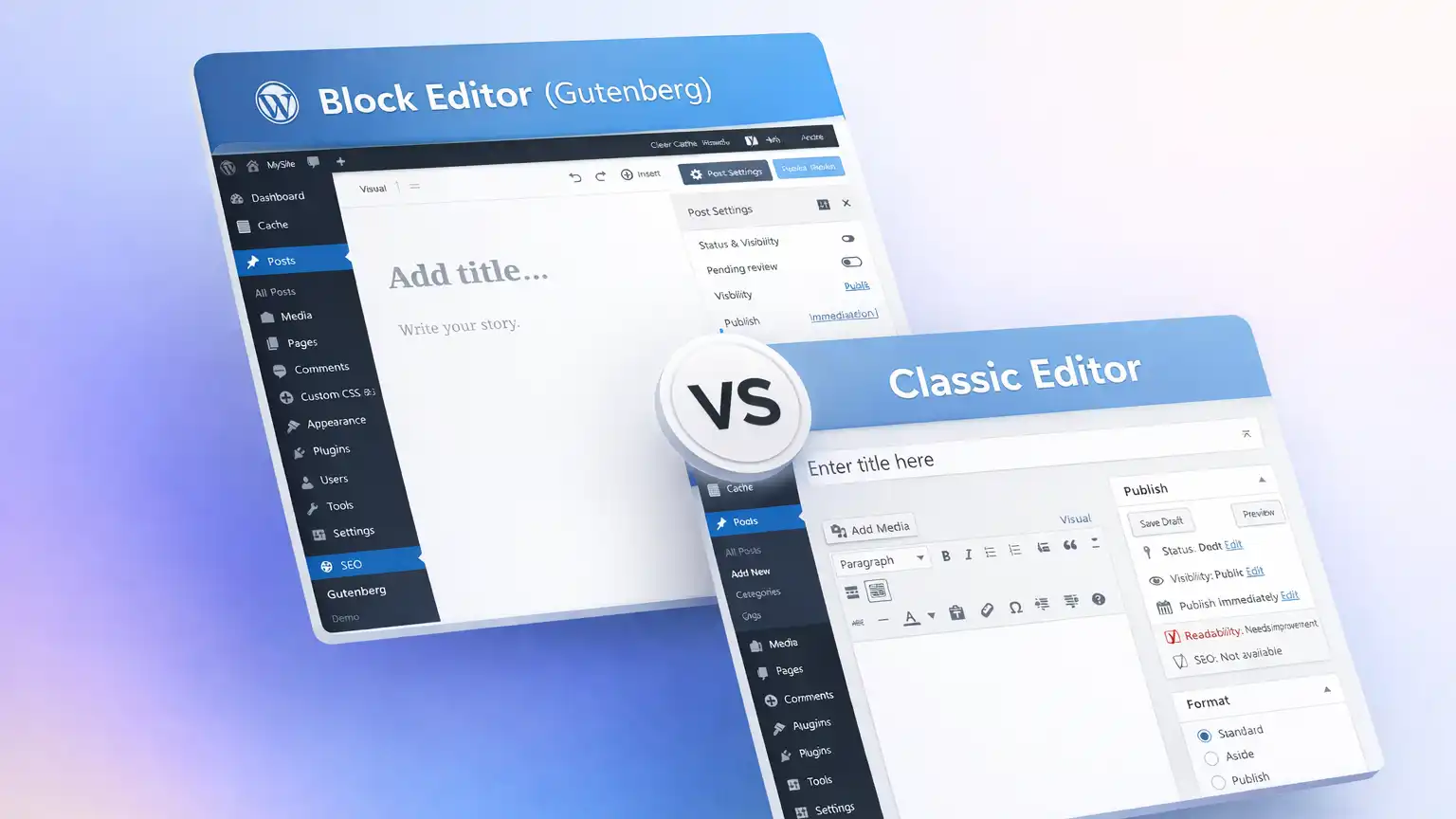
Block editors change more than the experience of writing a page. They can also change where layout and presentation decisions are stored, who controls those decisions, and how easily they can be changed later.
In a more template-driven CMS workflow, much of the presentation is controlled outside the article itself. A block editor can move some of that responsibility into the content editing environment, allowing authors to build columns, groups, media arrangements, reusable sections, and other page structures while publishing.
That flexibility is not inherently good or bad for maintenance. What matters is understanding which decisions are centralized and which are stored with individual pages. This is part of the broader maintainability problem discussed in Why Website Maintenance Gets Harder as Sites Grow.
NOTE: Block editors do not automatically make websites harder to maintain. They change where some structural and presentation decisions can be made, which changes what needs to be considered during future updates, redesigns, and content changes.
Content, Structure, and Presentation Can Live in Different Places
It is useful to separate three concepts that are often treated as though they are the same:
- Content is the information being published, such as text, images, headings, lists, and links.
- Structure determines how that information is organized within a page or across the website.
- Presentation determines how those elements are visually displayed.
CMS platforms have never kept these layers perfectly separate. Traditional editors can contain formatting, HTML, tables, classes, images, and other presentation-related information. Templates can also contain structural decisions rather than purely visual styling.
The difference with block editing is that the editing interface can give authors considerably more control over page structure and presentation without requiring them to edit the template.
A content editor may be able to create columns, grouped sections, buttons, media arrangements, spacing, backgrounds, or other page-level components directly within the article.
That changes where some of the website's design decisions live.
Template-Driven Publishing Centralizes More Decisions
In a strongly template-driven workflow, authors generally create content within an established page framework.
The template, theme, modules, widgets, or other site-level systems determine much of the surrounding layout. Articles published within the same section can therefore inherit common presentation without requiring the author to recreate it for every page.
A simplified workflow might look like this:
- create the article;
- organize the content with headings, lists, images, and links;
- assign the appropriate category or other CMS relationships;
- publish it within an existing site layout.
If the site later changes the width of its main content area, adjusts a shared heading style, moves a sidebar, or changes a common module position, the change may be handled centrally rather than by editing every article.
This is one advantage of centralized presentation: repeated decisions can often be changed in one place.
It does not mean template-driven websites are automatically easier to maintain. Templates can contain overrides, custom code, extension dependencies, and historical decisions of their own.

Block Editors Allow More Decisions Inside the Page
Block editors expand what can be controlled during publishing.
Depending on the CMS and editor, authors may be able to create:
- multi-column content;
- grouped page sections;
- buttons and calls to action;
- media-and-text arrangements;
- custom spacing and alignment;
- reusable blocks or patterns;
- page-specific presentation variations.
This can be extremely useful. A page that genuinely needs a different presentation no longer necessarily requires a new template or custom development.
The maintenance trade-off is that some decisions may now exist inside that page rather than in a shared structural layer.

Flexibility and Consistency Are Different Requirements
Block editing makes variation easier. That can be an advantage when pages have legitimately different requirements.
It can also make variation easier when there is no particular reason for pages to differ.
Suppose several authors independently create promotional sections. One uses two columns, another uses a group with a background, another adjusts spacing manually, and another builds something visually similar using different blocks.
The pages may all look acceptable when published.
The maintenance difference becomes visible later when the organization decides that every promotional section should change.
If those sections share a reusable pattern or centrally controlled component, the change may be relatively straightforward. If each was constructed independently inside individual pages, they may need to be identified and reviewed separately.
The issue is therefore not variation itself. It is whether repeated structures that should behave consistently are being managed consistently.
Reusable Patterns Can Restore Centralized Control
Modern block systems are not limited to independently constructed pages.
Reusable blocks, synchronized patterns, global styles, templates, and similar features can allow repeated structures to be managed centrally while retaining a block-based editing workflow.
This is an important distinction because otherwise the comparison between traditional and block editing becomes too simplistic.
| Approach | Where the decision lives | Maintenance implication |
|---|---|---|
| Template-controlled layout | Shared template or theme | Common changes can often be applied centrally |
| Independent page blocks | Individual content items | Repeated changes may require reviewing multiple pages |
| Reusable or synchronized patterns | Shared block-based component | Block flexibility can coexist with centralized updates |
| Page-specific exception | Individual page | Useful when the page genuinely requires different treatment |
The important maintenance question is not simply whether the website uses blocks. It is whether repeated decisions are centralized where centralization is useful.
Local Overrides Are Useful Until They Become the Common Case
A page-level layout adjustment is effectively an exception to the site's more general presentation rules.
Exceptions are often necessary. A landing page may need a different arrangement from a standard article. A product comparison may need columns that ordinary editorial content does not use.
Problems can emerge when the same exception is recreated repeatedly.
If authors repeatedly make the same spacing adjustment, rebuild the same group of blocks, or manually reproduce the same layout across many pages, that may indicate the design belongs in a reusable pattern, template, or shared style instead.
This is similar to a broader CMS configuration principle: configure the common case once and use local overrides for genuine exceptions.
The more frequently an exception is repeated, the more useful it becomes to ask whether it is still an exception.
Global Design Changes Can Expose Where Decisions Were Stored
A redesign is one of the clearest ways to see the maintenance consequences of an editing model.
Suppose a site changes its typography, spacing system, content width, button design, or common page components.
Elements controlled through shared styles and templates can often inherit the new design. Elements whose presentation was stored independently inside content may require additional review.
That does not mean every block-built page has to be manually rebuilt during a redesign. Much depends on how the editor stores its content and how heavily pages rely on local styling.
A disciplined block implementation can respond well to global style changes.
A site containing years of individually styled page sections may require more cleanup.
The maintenance consequence comes from the implementation, not merely from the presence of a block editor.
Editor Choice Can Affect Content Portability
Content portability becomes important during redesigns, editor changes, CMS migrations, and long-term preservation.
Plain editorial content such as headings, paragraphs, lists, images, and links is generally easier to reinterpret in another presentation environment than content whose meaning depends heavily on a particular layout system.
Block-based content can vary considerably in this respect.
Some systems store relatively portable structured content. Others may depend on editor-specific markup, comments, shortcodes, metadata, custom blocks, or plugins.
This means portability should be evaluated according to the actual editor and implementation rather than assuming all block content behaves the same way.
Questions worth asking include:
- What happens to the content if the editor or related plugin is removed?
- Does the underlying article remain understandable without its current presentation?
- Are important page elements based on standard blocks or proprietary components?
- Can repeated structures be changed centrally?
- How much cleanup would be required during a template or platform change?
These questions become more important when the website is expected to remain useful through several redesign or platform cycles.
Block Editors Can Shift Responsibility Toward Authors
When the editor provides extensive layout controls, authors can become participants in page design rather than only content creation.
That may be intentional. Some organizations want editors to have substantial control over page presentation.
Others want authors to concentrate on content while a smaller set of templates and patterns preserves visual consistency.
Neither model is universally correct.
The maintenance consideration is whether responsibilities are clear.
If authors are expected to create layouts, they need enough guidance to understand which patterns should be reused and which variations are appropriate. If layout is supposed to remain centralized, the editing environment should avoid requiring authors to reconstruct common designs manually.
Ambiguity creates more maintenance work than either model by itself.
More Editing Freedom Can Require Stronger Publishing Conventions
A constrained editor provides consistency partly by limiting the available choices.
A flexible editor can provide consistency through conventions instead.
Those conventions might define:
- which blocks are appropriate for ordinary articles;
- which layouts are reserved for special page types;
- when reusable patterns should be used;
- how headings should be structured;
- where custom spacing should be avoided;
- which presentation decisions belong in shared styles rather than individual pages.
Small websites managed by one person may handle these conventions informally.
Larger editorial teams may benefit from documented patterns because different authors otherwise make reasonable but inconsistent choices.
The objective is not to eliminate flexibility. It is to keep recurring decisions predictable enough that the website does not become a collection of unrelated page-building methods.
Block Editors Can Also Reduce Maintenance Work
The maintenance discussion should not focus only on additional complexity.
A well-designed block system can reduce maintenance work.
Reusable patterns can eliminate duplicated manual construction. Standard blocks can replace one-off custom HTML. Global styles can provide centralized presentation controls. Editors can create specialized pages without requiring a developer to produce a new template for every variation.
In some cases, moving an appropriate amount of layout control into the editor makes the website easier to operate because routine publishing no longer depends on technical template changes.
This is why the relevant question is not whether layout belongs entirely inside or outside content.
The better question is which decisions benefit from being global, which benefit from being reusable, and which genuinely need to remain page-specific.
Block Editing Changes What Needs to Be Tested
When layout exists partly inside content, CMS or editor changes may affect more than the writing interface.
Updates can potentially change block rendering, editor controls, shared styles, custom blocks, or integrations that individual pages rely on.
This does not mean block-editor updates are unusually dangerous.
It means testing should reflect the way the website is built.
A site using only standard text and image blocks may require relatively simple checks. A site using custom blocks, third-party block libraries, complex reusable patterns, and extensive page-level layouts has more relationships worth testing.
The same principle applies elsewhere in CMS maintenance: test according to the dependencies that actually exist.
This relationship is explored more broadly in Why CMS Updates Sometimes Break Websites.
Block-Based Layout Can Become Part of Website Structure
Not every structural decision belongs to navigation, categories, templates, or modules.
The arrangement inside individual pages also influences how visitors encounter information.
Blocks can establish visual hierarchy, group related material, place supporting information beside primary content, and create repeated page-level patterns.
Those are meaningful structural decisions even though they occur inside the article.
For maintenance purposes, it helps to recognize this distinction. Website structure can exist at several levels:
- site-wide navigation and hierarchy;
- categories and content relationships;
- template and module regions;
- reusable page patterns;
- structure within individual content items.
A block editor primarily expands control over the lower levels. It does not replace the broader architecture of the CMS.
The Maintenance Question Is Where Decisions Live
Block editors are neither inherently more maintainable nor inherently less maintainable than traditional editing workflows.
They provide a different distribution of control.
A website that uses blocks deliberately can combine flexible publishing with shared templates, reusable patterns, global styles, and clear conventions. A website that creates every page independently can accumulate presentation decisions that are harder to change consistently later.
Traditional workflows have their own maintenance risks when templates, overrides, extensions, and customizations become difficult to understand.
The practical questions are therefore:
- Which decisions are global?
- Which structures are reusable?
- Which choices are intentionally page-specific?
- What happens when a common design needs to change?
- What dependencies does the editor introduce?
- Can the underlying content survive a future redesign or editor change?
Answering those questions makes the editing model easier to maintain because it reveals where future work will actually occur.
Block editors change website maintenance when they change where structural and presentation decisions are stored. The editor itself is only one part of that system.
Related Website Maintenance Articles
Explore additional articles covering website maintenance, stability, updates, and long-term site management.