

Most people don’t actively choose how their CMS works. They accept what is presented to them first. Editors, settings, structures, and workflows are adopted not because they were evaluated, but because they were default. Over time, those defaults quietly shape how a website is built, maintained, and understood, often far more than the platform itself.
Defaults Are Decisions Made in Advance
A CMS default is not a neutral starting point. It is a decision made, usually with good intentions. Defaults exist to reduce friction, speed up onboarding, and help people get something published quickly.
The problem is not that defaults exist, but that they are rarely revisited to update. Once a default workflow is adopted, it tends to become invisible. Users stop noticing alternatives and begin to assume that the way the system behaves is simply “how websites work.”
Defaults influence:
- How content is created and edited
- Which settings are considered safe to change
- How structure and navigation evolve
- What feels normal versus risky
Because these choices are made early, they compound over time. What started as a convenience becomes a constraint, not because the CMS is limiting, but because habits and expectations have already formed.
How Defaults Shape Workflow Without Being Obvious
Defaults rarely announce themselves as workflow choices. Instead, they guide behavior quietly by making certain actions easy and others slightly harder. Over time, those small differences accumulate into a clearly defined way of working, even if the user never consciously chose it.
When a CMS opens directly into a specific editor, presents a particular page structure, or encourages content to be created in a certain format, it is teaching the user how to publish. The workflow becomes familiar through repetition, not explanation. Of course, everyone is going to see this differently. Let me give you an example of how I use defaults for the GeJay Media website. I set specific options for articles, but I also have the option to change them based on making changes based on the article:
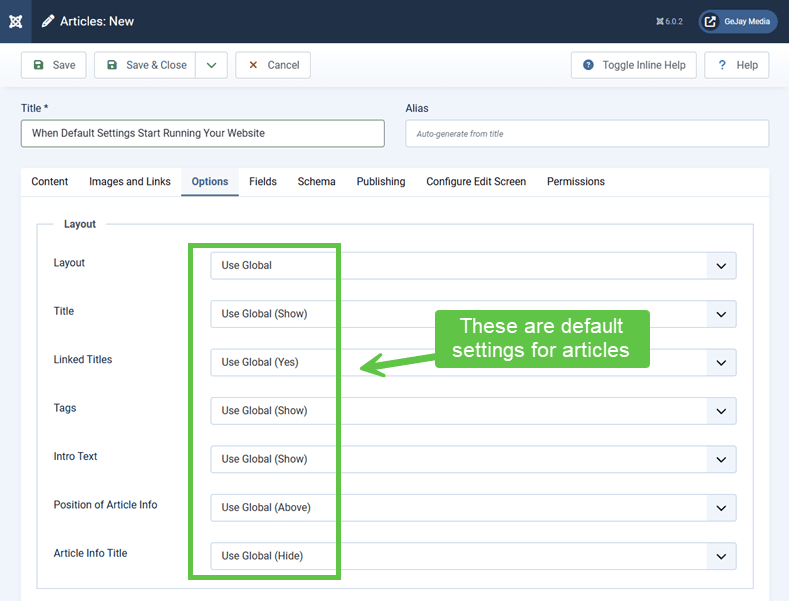
Because this guidance is implicit, it often goes unquestioned. Users adapt their thinking to match the system rather than evaluating whether the system’s assumptions align with their goals. What feels intuitive is usually what the CMS has trained them to expect based on select settings and options.
This is why changing workflows later can feel uncomfortable or even wrong. Alternatives are not rejected because they are objectively worse, but because they violate habits that were formed early. Defaults create muscle memory, and muscle memory is difficult to override without a clear reason.
In practice, this means two people using the same CMS can have very different experiences depending on which defaults they accepted, modified, or resisted early on. The platform remains the same, but the workflow diverges.
Defaults Create Long-Term Expectations
Once a default workflow is established, it begins to shape expectations about what a CMS should and should not do. Features that align with the default feel natural, while alternatives can feel unnecessary, confusing, or even wrong. Over time, these expectations harden into assumptions.
This is especially noticeable when users encounter a different CMS or a different configuration of the same CMS. What one system treats as normal may feel overly rigid or overly complex in another, not because the systems are inherently better or worse, but because their defaults trained users to expect different things.
Defaults influence how people think about:
- What “good” content editing looks like
- How much structure is expected up front
- Whether layout decisions belong early or late
- Who is responsible for maintaining consistency
These expectations also affect how advice is interpreted. Recommendations that align with a user’s default experience are readily accepted, while advice that challenges those assumptions is often dismissed as impractical or outdated.
Over time, defaults stop feeling like choices at all. They become the baseline against which everything else is judged, even when the original reasons for those defaults no longer apply.
When Defaults Become Invisible Constraints
Defaults are most helpful at the beginning, when getting something published quickly matters more than long-term optimization. The problem arises when those same defaults remain in place long after a site has outgrown its initial needs.
Because defaults fade into the background, they often stop being evaluated. What once reduced friction can quietly introduce limitations, not because the CMS is incapable, but because the site’s structure, content, and workflows were built around assumptions that are no longer questioned.
These constraints tend to surface indirectly. A site may become harder to reorganize, navigation changes may feel risky, or design updates may require more effort than expected. At that point, the issue is often attributed to complexity or technical debt, when the real cause is an unexamined default that shaped early decisions.
Defaults also influence what feels safe to change. Settings that were never adjusted early on may later feel untouchable, even when documentation or experience suggests otherwise. This hesitation reinforces the constraint; adapting feels more dangerous than staying the same.
In many cases, the CMS offers ways to work differently, but those options are discovered only after frustration sets in. By then, changing direction can feel like undoing years of accumulated habits rather than making a straightforward adjustment.
Why Defaults Matter More Than Platform Choice
Discussions about CMS platforms often focus on which system is better, more powerful, or more future-proof. In practice, defaults frequently have a greater impact on long-term outcomes than the platform itself. Two sites running the same CMS can behave very differently depending on which defaults were accepted and which were deliberately changed.
Platform choice sets the boundaries of what is possible, but defaults determine what actually happens day to day. They influence how content is created, how structure evolves, and how comfortable owners feel making changes. Over time, these factors shape maintenance habits and expectations more strongly than feature lists ever do.
This is one reason CMS comparisons often talk past the real issue. When users argue about flexibility, complexity, or ease of use, they are often reacting to default workflows rather than inherent platform capabilities. The same CMS can feel empowering or restrictive depending on how it is configured and learned.
Understanding this helps reframe CMS selection decisions. Instead of asking which platform is best in the abstract, it becomes more useful to ask which defaults align with how you want to work, and which ones you are willing to revisit or override as your site grows.
This perspective also explains why switching platforms rarely solves deeper frustrations on its own. Without addressing workflow expectations shaped by defaults, the same patterns often reappear in a different system under a different name.
For broader context on CMS comparisons and long-term tradeoffs, see WordPress vs Joomla and Choosing Your CMS.
Making Defaults Visible Again
Defaults are not a problem to be eliminated. They are a starting point. The real issue is allowing them to remain invisible long after a site has matured beyond its initial setup.
Making defaults visible again starts with awareness. It means periodically stepping back and asking why certain workflows feel normal, which assumptions are being relied on, and whether those assumptions still serve the site’s goals. This kind of reflection is rarely prompted by the CMS itself, but it pays long-term dividends.
When defaults are examined intentionally, they become choices rather than constraints. Some may be reaffirmed because they continue to work well. Others may be adjusted gradually as needs change. In both cases, the site becomes easier to manage because changes are driven by understanding rather than reaction.
This approach also reduces frustration when encountering advice or alternative workflows. Instead of dismissing unfamiliar ideas outright, they can be evaluated against existing defaults and goals. Disagreement becomes a question of fit rather than right or wrong.
Ultimately, CMS defaults matter because they shape behavior quietly and persistently. By bringing them back into view, site owners regain control over how their sites evolve, making long-term stability and clarity easier to maintain.