

Most website problems do not begin with a bad choice. They begin when no choice is made at all. When a site is first launched, defaults feel helpful. They reduce friction, remove uncertainty, and let things work without demanding decisions. For a new site owner, this feels like progress. Pages load, updates run, emails are sent, and backups exist somewhere in the background.
The issue is not that default settings are wrong. The issue is that they quietly become the system that governs your site long after you stop noticing them.
The comfort of letting the platform decide
Modern website platforms are designed to get you online quickly. They make assumptions about what most people need, what should happen automatically, and what trade-offs are acceptable at the beginning.
Those assumptions are not careless. They are simple, practical starting points. Automatic updates reduce security risks to a certain point. Default layouts prevent blank pages. Preset performance options help pages load faster without configuration.
What often gets missed is that these settings were chosen for speed and accessibility, not for long-term ownership. Once the site is live, those starting points often remain unchanged. What began as convenience slowly turns into governance. In other words, it makes things easier (convenience), eventually becoming a rigid, mandatory, and structural system (governance).
Defaults are not neutral over time
A default setting is not passive. It represents a decision made on your behalf.
Over time, those decisions shape how your site responds to change. This is why two sites using the same platform can behave very differently. The platform itself is only the base layer. The real system is the accumulated set of defaults that were accepted, settings that were never revisited, and automated processes that continued running without oversight.
As a site grows, these invisible choices begin to matter more. Performance issues become harder to diagnose. Updates introduce surprises. Features interact in ways that feel unpredictable. None of this happens suddenly as it accumulates over time.
Where defaults usually take control first
For new site owners, defaults tend to concentrate in a few core areas. These are not advanced settings. They are foundational ones that quietly shape how the site operates day to day.
Core functional defaults
These are the settings that define how the site presents itself and how users interact with it.
- General configuration, such as timezone, language, and date formats
- Account and profile visibility rules for new users
- Security basics like password rules, session lengths, and optional two-factor authentication
- Content and display defaults such as text sizing, homepage layout, or light and dark modes
These defaults rarely cause immediate problems. Their impact shows up later, when content grows, users increase, or the site begins to represent something more serious than a test project.
Performance and automation defaults
Performance-related defaults are often enabled with good intentions. They are meant to protect data, improve speed, and reduce technical risk.
- Automatic saving features are designed to prevent content loss
- Search engine-related settings like metadata generation and sitemap creation
- Caching and image optimization rules are applied globally
Left unchecked, these systems can obscure problems rather than solve them. When something goes wrong, it becomes harder to tell whether the issue comes from content, configuration, or automation acting in the background.
The trade-offs of relying on defaults
Defaults are neither good nor bad by themselves. They are trade-offs. Understanding those trade-offs is what separates short-term setup from long-term stability.
| Benefit | Cost Over Time |
|---|---|
| Faster setup and fewer early decisions | Less understanding of how the site actually works |
| Automatic protection against common mistakes | Hidden complexity when something fails or conflicts |
| Reduced technical effort for beginners | Harder troubleshooting as the site grows |
| Consistency across new installations | Limited alignment with specific goals or content types |
Most long-term frustration does not come from choosing defaults. It comes from forgetting that a choice was made at all.
Why this matters more as your site matures
In the early stages, a website is simple. There are fewer pages, fewer users, and fewer moving parts. Defaults usually hold up well at this scale.
As content expands and traffic increases, the cost of invisible decisions rises. A caching rule that once helped may now hide errors. An automatic update process may introduce changes without warning. A backup system that worked months ago may no longer restore cleanly.
At this point, many site owners feel like the platform has become unreliable. In reality, the system is doing exactly what it was configured to do. The challenge is that the configuration was never intentional.
What intentional control actually looks like
Intentional control does not mean turning everything off or constantly adjusting settings. It means understanding which parts of your site operate automatically and knowing where to intervene if needed.
For a new site owner, this starts with awareness. If a process runs automatically, you should be able to answer three questions:
- What is this responsible for?
- What would change if it stopped or behaved differently?
- Where would I adjust it if I needed to?
If those answers are unclear, the site is being governed by defaults instead of intent.
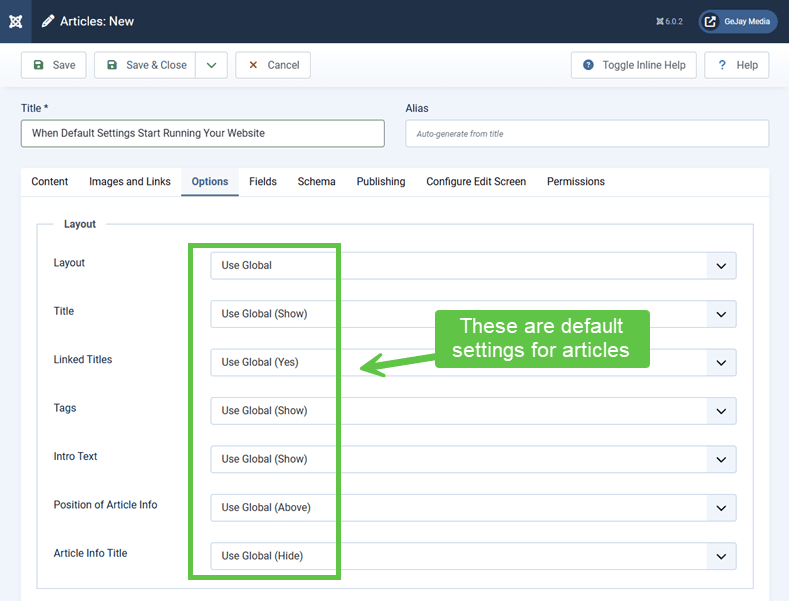
Let me give you a great example of intentional default settings, using this article I am writing using Joomla:
Defaults as starting points, not final answers
Platforms rely on defaults because, without them, most people would never get started. The goal is not to reject defaults, but to grow beyond them deliberately.
Stability improves when defaults become visible and adjustable rather than invisible and assumed. This does not require technical expertise. It requires shifting from passive use to informed ownership.
Long-term site health is not about constant optimization. It is about reducing surprises. Defaults stop being risky when they stop being invisible.
From automatic to intentional
A stable website is not defined by features or tools. It is defined by understanding.
If your site relies heavily on automatic systems, that is not a problem. The problem appears only when those systems can change the site tomorrow, and you would not know where to look or what to adjust.
Defaults are how a site begins. Intent is how it lasts.